

DL-96A 3020 Bacterial Identification and Antimicrobial Susceptibility Testing System
Keywords:
Category:
Detailed description
[Product Introduction]
It is suitable for species- and genus-level identification of isolated bacteria and fungi, as well as for the simultaneous determination and analysis of minimum inhibitory concentrations (MICs) of various antimicrobial agents against these bacteria.
Fully automated throughout
The instrument can perform automated incubation, automatic addition of auxiliary reagents, automated detection, and automatic disposal of plates.
Comprehensive testing scope
The identification covers more than 600 clinically common bacterial species, including Gram-positive cocci, Gram-negative bacilli, Neisseria, Haemophilus influenzae, Moraxella catarrhalis, Corynebacteria, and fungi.
High-throughput screening
Enables high-throughput testing, capable of processing 60 samples at once; results are available on demand, with identification and antimicrobial susceptibility testing reported in as little as 8 hours.
Advanced Expert System
An advanced expert system provides scientifically grounded annotations of antimicrobial susceptibility results, identifying multiple common resistance phenotypes.
[SCAN-10 Automatic Sampler]
1. The automated sampler is controlled by a microcomputer program, operates fully automatically, and performs automatic sample addition.
2. Eliminate instances of under‑addition, over‑addition, or omission caused by human oversight.
3. Lightweight and flexible, highly adaptable, with stable performance and short sample‑addition time.
4. Able to meet the laboratory’s requirements for rapid, accurate, and high-throughput testing.
5. Can be placed inside a biosafety cabinet for automated sample addition, thereby preventing sample contamination and ensuring biosafety.
[DL-96 Series Bacterial Assay System Randomized In Vitro Diagnostic Reagent Plates]
Product model numbers: DL-96E, DL-96NE, DL-96STAPH, DL-96STREP, DL-96FUNGUS
This reagent plate is used for the identification of clinical pathogenic bacteria and for the semi-quantitative determination of antimicrobial MICs.
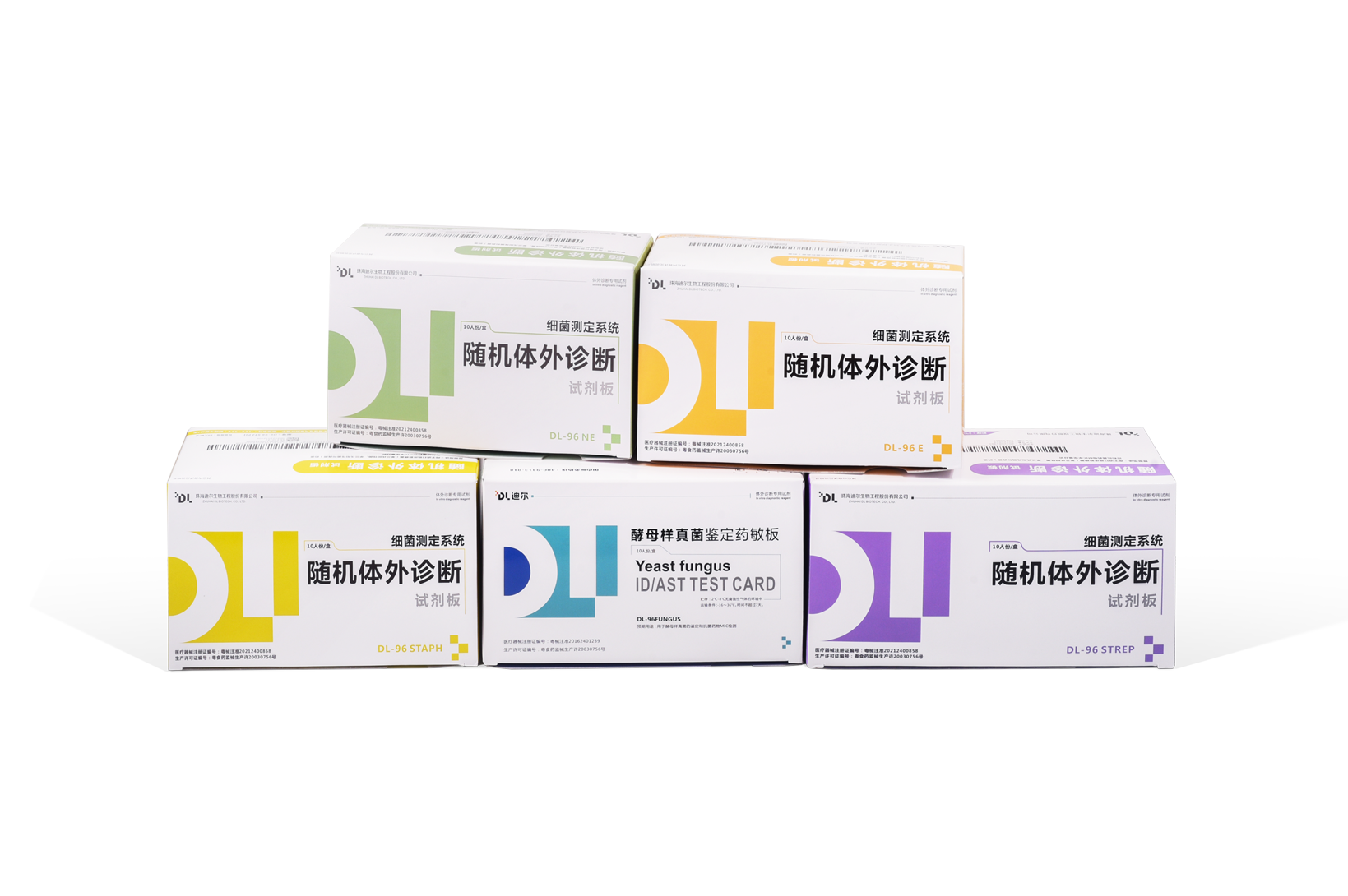
1. The antimicrobial concentration gradients are extensively established, and all values are based on measured MICs.
2. A wide variety of drugs is available, with each bacterial assay plate containing more than 20 drug types.
3. A variety of reagent plates are available, covering the identification and antimicrobial susceptibility testing of common clinical pathogens.
4. The identification and antimicrobial susceptibility assay plates are sealed with a transparent film, effectively preventing contamination.
[DL-120 Series Identification and Antimicrobial Susceptibility Test Plate]
Product models: DL-120E, DL-120NE, DL-120STAPH, DL-120STREP, DL-120NH, DL-120-Coryne
This reagent plate is used for the identification of clinical pathogenic bacteria and for the semi-quantitative determination of antimicrobial MICs.
1. Added several clinically important commonly used antibiotics, such as moxifloxacin, tigecycline, and daptomycin.
2. Increasing the range of measured drug concentrations expands the MIC assay’s detection window, facilitating the monitoring of trends in bacterial resistance.
3. Six types of test cards are available, including the Enterobacteriaceae card, the Non-Fermenting Bacteria card, the Staphylococcus (Micrococcus) card, the Streptococcus (Enterococcus) card, the Neisseria/Haemophilus card, and the Corynebacterium card.
4. The identification and antimicrobial susceptibility assay plates are sealed with a transparent film, effectively preventing contamination.
Recommended Products
Product Message
Dier Bio: Making infectious disease diagnosis faster and more accurate.
Are you ready to embark on a journey into the world of microbes?


Deer Bio WeChat Official Account
Tel: 0756-3391888
Address: No. 59, Dingwan Tenth Road, Jinwan District, Zhuhai City
Email: market@medicaldl.com
dl@medicaldl.com (for export business)
National After-Sales Customer Service Hotline: 400-9313-018
International Customer Service Hotline: +86 756 6292044
©2026 Zhuhai Dir Bioengineering Co., Ltd.Website Development: China Enterprise Dynamics Zhuhai
SEO tags
Sorry, there is currently no content in this section.
You can view other sections.
Sorry, there is currently no content in the current column
You can check other sections
Business license
Business License