

DL-96A Fully auto microbial identification and antimicrobial susceptibility testing system
Keywords:
Category:
Detailed description
DL-96A Bacterial Identification and Antimicrobial Susceptibility Testing System (Non-Clinical)
【Product Features】
Automatic barcode scanning, automatic incubation, automatic detection, automatic addition of auxiliary reagents, and automatic disposal of reagent cards.
A highly automated antimicrobial susceptibility testing system minimizes manual operations, thereby enhancing work efficiency.
It can simultaneously incubate and analyze 60 reagent plates, and its independent detection modules enable on‑demand testing.
Identification and antimicrobial susceptibility testing can yield results in as little as 8 hours.
Integrated engineering design, eliminating the need to connect external devices;
Accuracy: The accuracy of identification for quality-control strains is ≥95%; the accuracy of semi-quantitative MIC determination for quality-control strains is ≥95%.
Repeatability: The repeatability of identification of quality-control strains is ≥95%; the repeatability of semi-quantitative MIC determination for antimicrobial agents using quality-control strains is ≥95%.
Equipped with an automated sample‑addition system, it enables samples to be automatically dispensed into the assay reagents, eliminating manual handling and ensuring rapid, accurate dispensing. Sample volume range: 30–1000 μL; dispensing accuracy: for volumes ≤100 μL, ±1 μL; liquid‑dispensing time per assay plate: ≤40 s.
All test cards feature a thin-film sealing design to prevent biological contamination.
The identification and antimicrobial susceptibility cards/plates feature a sealed design to prevent contamination.
[Application Areas]
Disease control systems, food and drug testing systems, research institutions, testing agencies, veterinary systems, customs systems, university faculties, biopharmaceutical companies, blood banks, and others.
[Types of Appraisal]
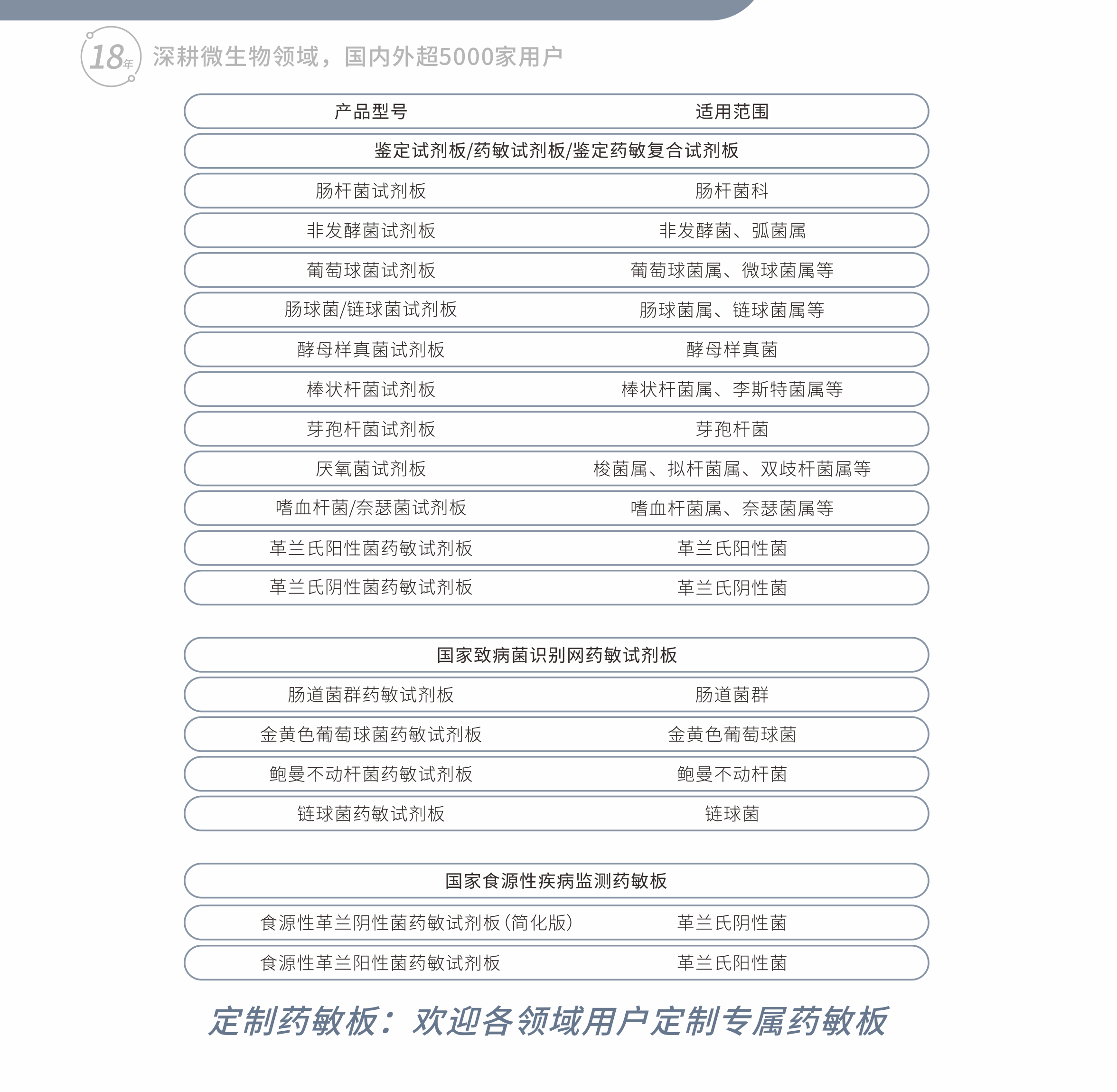
Identification of nearly 1,000 microbial strains, including Gram-negative bacteria (such as Enterobacter spp.), Gram-positive bacteria (such as Staphylococcus spp.), non-fermenting bacteria, Micrococcus spp., Streptococcus spp., Enterococcus spp., Shigella spp., Salmonella spp., Vibrio spp., Campylobacter spp., Corynebacterium spp., Listeria spp., Neisseria spp., Haemophilus spp., Bacillus spp., anaerobic bacteria, yeasts, and fungi.
[Types of Antimicrobial Agents]
There are more than 200 classes of antimicrobial agents, including cephalosporins, penicillins, aminoglycosides, quinolones, macrolides, glycopeptides, tetracyclines, nitrofurans, carbapenems, monobactams, β‑lactam/β‑lactamase inhibitor combinations, pleuromutilins, phenicol derivatives, fluoroquinolones, lincosamides, oxazolidinones, and others.
[Customized Antimicrobial Susceptibility Plate]
Recommended Products
Product Message
DL Biotech: Making infectious disease diagnosis faster and more accurate.
Are you ready to embark on a journey into the world of microbes?


DL Biotech WeChat Official Account
Tel: 0756-3391888
Zhuhai DL Biotech Co., Ltd.
Address: No. 59, Dingwan 10th Road, Jinwan District, Zhuhai City
Email: market@medicaldl.com
dl@medicaldl.com (for export business)
National After-Sales Customer Service Hotline: 400-9313-018
International Customer Service Hotline: +86 756 6292044
©2026 Zhuhai DL Biotech Co., Ltd.Website Development: China Enterprise Dynamics Zhuhai
SEO tags
Sorry, there is currently no content in this section.
You can view other sections.
Sorry, there is currently no content in the current column
You can check other sections
Business license
Business License